Chapter 1: The Silent Anxiety of Sourcing from China
Sourcing products from China is one of the most effective ways to scale a global B2B or e-commerce business. However, for most overseas buyers, the period between sending a 30% deposit and receiving the shipping container is filled with quiet, persistent anxiety.
Without a local office or team on the ground, importing goods feels like playing a high-stakes lottery. You are wiring thousands of dollars to an entity thousands of miles away, crossing your fingers, and hoping that what arrives at the destination port matches your expectations.
If you have ever sourced products via Alibaba, Made-in-China, or Google, you have likely experienced one of the three core anxieties that haunt global importers:
1. The Identity Trap: Factory vs. Trader
Every importer wants to work directly with the manufacturer. Working with a factory means lower costs, direct control over product customization, and faster communication. Naturally, almost every supplier online claims to be a "100% manufacturer with our own factory."
But in reality, a significant portion of these "factories" are trading companies, sourcing agents, or even single-person operations working from a residential apartment (often referred to as SOHO traders). They use stock photos of industrial machinery, steal videos of assembly lines from YouTube, and present themselves as manufacturing giants.
2. The Payment Black Hole: Beneficiary Mismatch
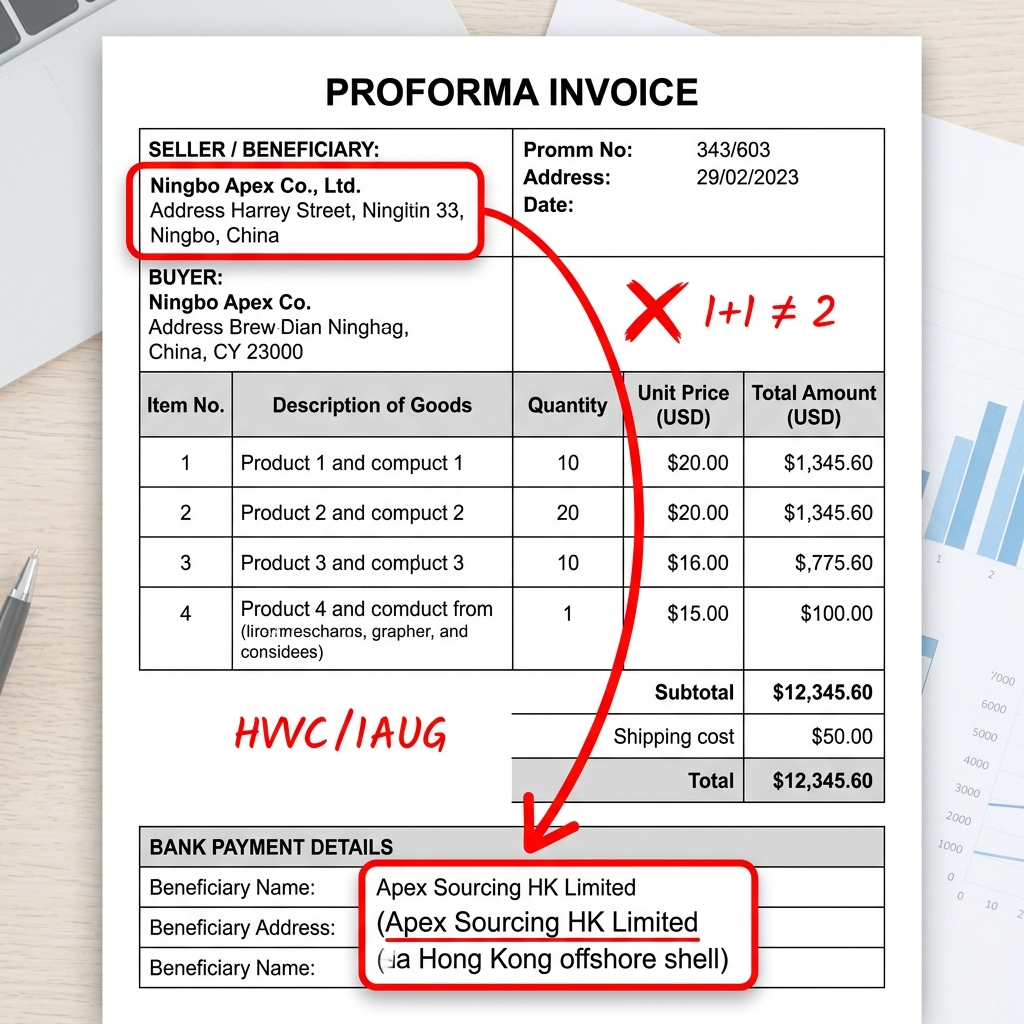
The moment of truth in any sourcing journey is the payment of the deposit. You receive a Proforma Invoice (PI) from your contact person. You look at the payment details, and a red flag pops up: The company you are communicating with is Ningbo Apex Industrial Co., Ltd., but the bank beneficiary name on the invoice is Apex Trading HK Limited (a Hong Kong offshore entity) or, worse, a personal bank account under the name Zhang San.
When you ask the salesperson about this mismatch, they give a standard response: "This is our offshore company for tax-saving purposes. It is completely safe." If the supplier disappears after receiving your deposit, your local bank and law enforcement cannot help you. In international law, you wired money to Entity B, while your purchase contract was with Entity A. Your money is gone forever.
3. The Certificate Mirage: Will Customs Seize My Goods?
To import products like electronics, medical devices, toys, or cosmetics into regions like the US or the EU, your products must meet strict regulatory compliance standards. Your supplier confidently sends you beautiful PDF copies of CE, FDA, FCC, or ISO certificates.
You proceed with production, only for the shipping carrier to contact you weeks later: Your goods have been seized by customs because the certificates are invalid or fraudulent.Many suppliers use "photoshopped" or rented certificates. They take a certificate issued to a different company, edit the company name to match theirs, and present it to unsuspecting buyers.
Chapter 2: The Roots of Sourcing Blindness: Why B2B Platforms Fail to Protect You
When buyers encounter supplier risks, their first reaction is often frustration with B2B marketplaces. "I found them on Alibaba, and they had a 'Gold Supplier' badge and a 'Verified' checkmark! How did I still get scammed?"
To protect your business, you must understand the structural reasons behind this information asymmetry. The vulnerability does not exist because you are inexperienced; it exists because of how B2B platforms and cross-border commercial systems are built.
The Pay-to-Play Model: Is Alibaba Gold/Verified Status Reliable?
The short answer: It is a basic compliance baseline, not a stamp of safety.
A "Gold Supplier" badge is not an award earned through excellent service. It is a commercial membership package. Any company that pays the annual subscription fee and passes a basic administrative check (proving they are a registered business entity) can become a Gold Supplier.
While B2B platforms hire third-party inspection firms (like SGS or TÜV Rheinland) to conduct on-site audits, these audits have significant limitations:
- Static Snapshots: An audit conducted two years ago does not reflect the supplier's current status. They might have lost their factory, laid off their staff, or run into severe debt since the inspectors left.
- Surface-Level Checks: Inspectors verify that a production line exists in a building, but they do not check if the supplier is renting that line temporarily, or if they outsource 90% of their orders during peak seasons.
- No Transaction Integration: The audit validates the company's existence, but it does not check if the Proforma Invoice (PI) they emailed you contains a mismatched third-party bank account.
The Language Wall: English Aliases vs. Legal Chinese Names
In China, only the official Chinese company name has legal standing. Under Chinese corporate law, there is no official registry for English names. If a Chinese company wants to open a bank account, sign a lease, register a factory, or sue a supplier, they must use their Chinese name (e.g., Shenzhen SuperLED Chinese entity).
The English name you see on Alibaba or their website (e.g., Shenzhen SuperLED Co., Ltd.) is merely an unofficial translation. This creates a massive loophole: a supplier can use a legitimate-looking English name on their website, but issue contracts under a completely different Chinese entity that has a history of lawsuits or financial distress. Because you do not know their legal Chinese name, you cannot look them up in China's national court registries or corporate database.
The Offline/Online Disconnection
Online profiles are highly polished marketing materials. Offline, however, the reality can be collapsing. Commercial B2B platforms do not sync with China's local judicial databases, tax registries, or credit networks in real time. If a supplier is currently embroiled in lawsuits for failing to deliver goods to domestic buyers, or if they have been blacklisted by the government as "dishonest debtors" (失信被执行人), their online storefront will continue to look perfectly normal.
Chapter 3: The Illusion of "Easy Verification": The Hidden Roadblocks in Official Databases
When foreign buyers realize that Alibaba badges are not enough, they usually ask: "Why can't I just search China's government registry database directly? Isn't it public and free?"
Yes, China has a very advanced official registry database: the National Enterprise Credit Information Publicity System (NECIPS). It is the ultimate source of truth, containing official corporate status, registration addresses, legal representatives, and records of violations for every registered company in the country. In theory, you can search any company for free. In reality, you will face four major digital roadblocks:
- The Language Barrier & English-to-Chinese Search: The official registry system is entirely in Chinese. There is no English interface. Furthermore, you cannot search using English company names. You must first translate or trace the exact legal Chinese name of the company (e.g.,
Shenzhen SuperLED Chinese entity). - The Chinese SMS Verification & Registrations Wall: You can no longer browse anonymously. You must register an account, which requires SMS verification via a Chinese mobile number (+86). For deep corporate risk history searches, the system requires identity linkage, which often includes facial recognition via WeChat or inputting a Chinese National ID number.
- The Hanzi CAPTCHA Trap:Every search query triggers a security CAPTCHA where you must click on Chinese characters in a specific order (e.g., "Select the characters in the order of '诚信经营'"). If you do not read Chinese, solving these is virtually impossible.
- A verified Chinese contact who is willing to use their mobile phone number and ID to register an account for you.
- Professional Translation Tools: OCR tools to scan documents (like Proforma Invoices) to extract Chinese characters from red official stamps.
- An Anti-Fraud Mindset: Cross-reference the document's Unified Social Credit Code (USCC) against the live database, never trusting the paper document itself.
Chapter 4: The 5-Step Logical Verification Process: How to Spot "1+1 ≠ 2" Discrepancies
An audit is not about searching for a single red flag. It is about applying the "1+1 = 2" Logical Consistency Rule. In business, facts should align logically. If your supplier claims Statement A, but a third-party official record displays Statement B, then $1+1 \neq 2$. This logical conflict is your proof of risk.
1Corporate Existence & Official Status Audit
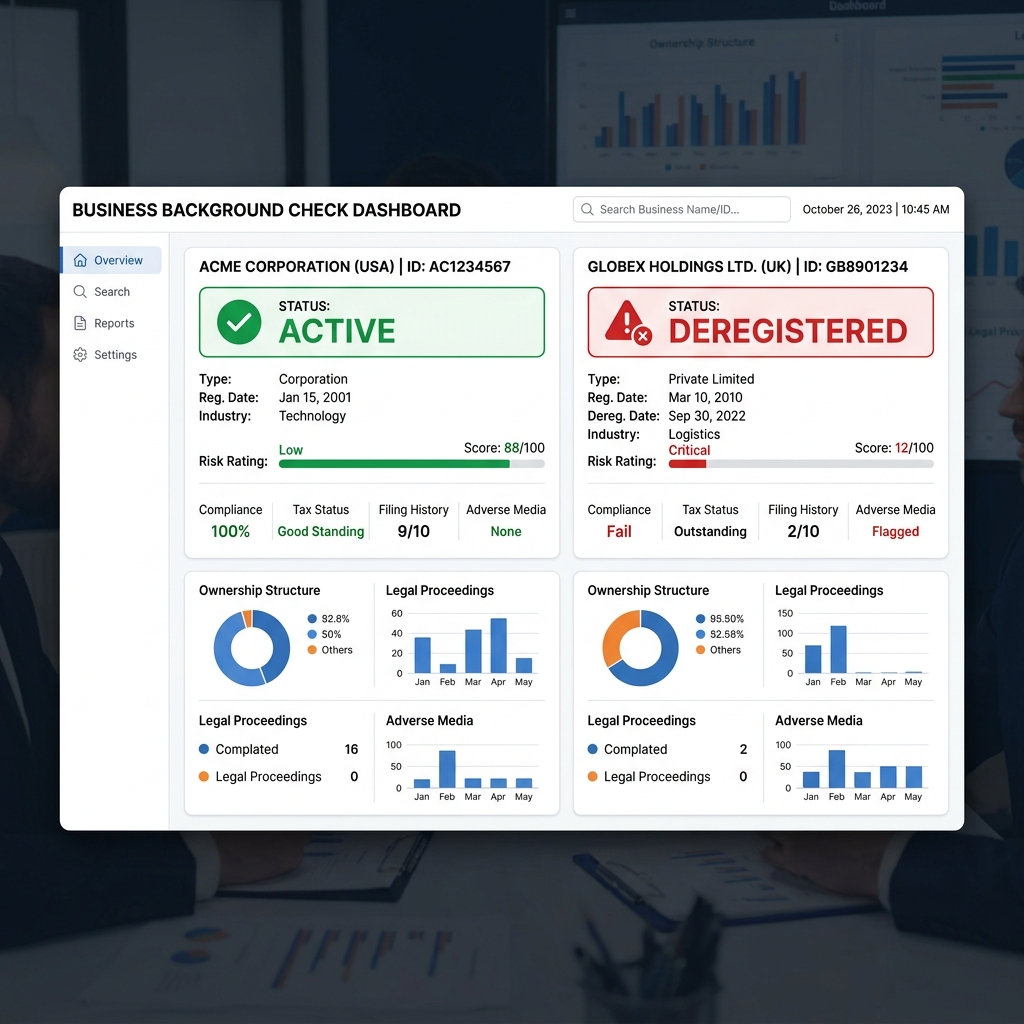
The supplier's online catalog is active and receiving orders (1). Therefore, their official business status in the government database must be "Active / Operating" (1).
The Inconsistency (1+1 ≠ 2): You search the Unified Social Credit Code (USCC) on the official registry, and the company status shows “Deregistered” (注销), “Revoked” (吊销), or is flagged under the “Abnormal Operations List” (经营异常名录) due to an untraceable physical address.
2The Factory Claim vs. Registered Business Scope & Location
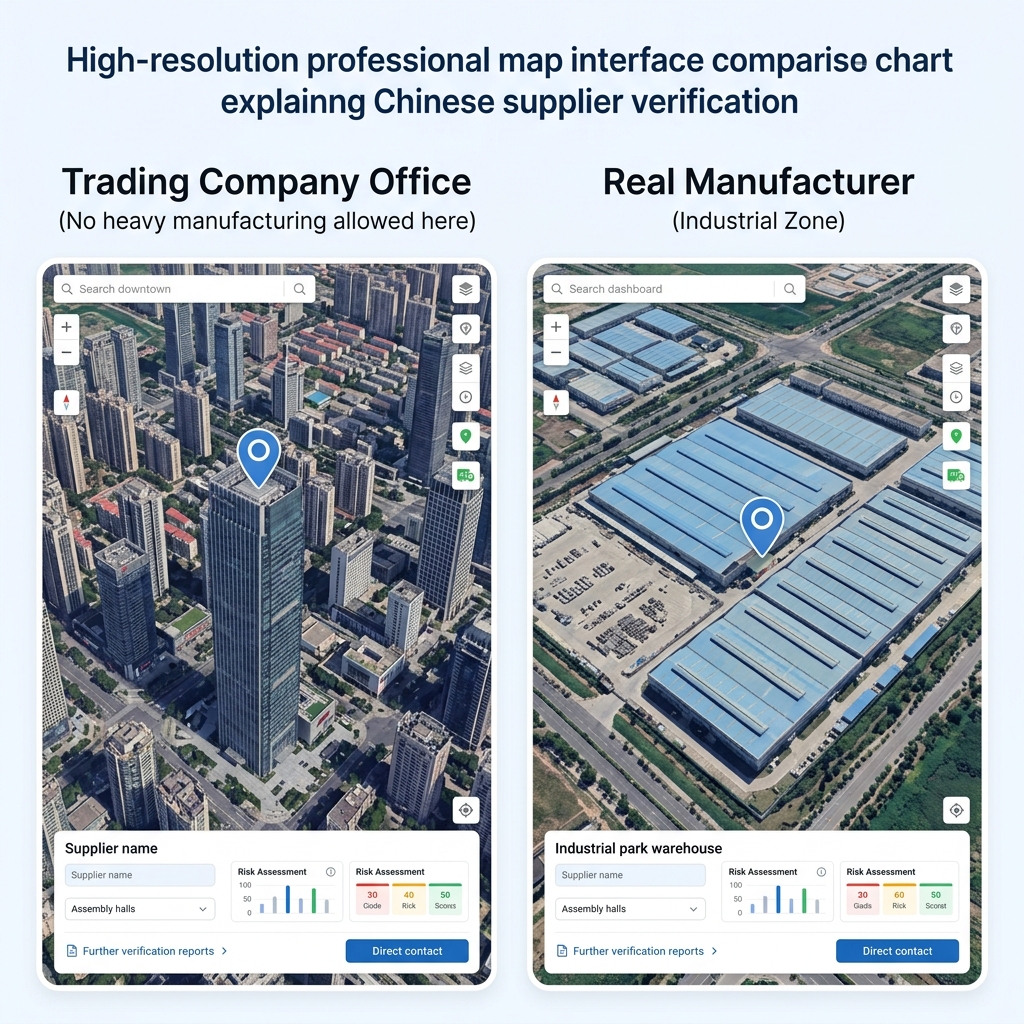
The supplier claims, "We are a leading factory manufacturing customized LED lights" (1). Therefore, their official business scope must include manufacturing terms, and their registered address must be an industrial zone (1).
The Inconsistency (1+1 ≠ 2):
- Mismatch A: You translate the official "Business Scope" (经营范围) and find only commercial words like "Sales, Retail, Import & Export" (销售, 零售, 进出口), with zero manufacturing words like "Production, Manufacturing, Processing" (生产, 制造, 加工).
- Mismatch B: You plug their registered address into a map search and it points to a 20-story commercial office building or a residential apartment. You cannot run a manufacturing plant inside an office cubicle.
3Bank Payee Matching vs. Exporter Legal Entity
Your Proforma Invoice (PI) is issued by Ningbo Yinzhou Import & Export Co., Ltd. (1). Therefore, the bank beneficiary name on the invoice must be Ningbo Yinzhou Import & Export Co., Ltd. (1).
The Inconsistency (1+1 ≠ 2): The salesperson asks you to wire money to Apex Industrial Sourcing Limited (a Hong Kong registered offshore entity) or to a personal bank account under a manager's name (e.g., Li Wei), claiming it is their "parent company" or "financial agent," but they refuse to provide a signed, sealed trilateral agreement.
4Product Certification Authenticity Check
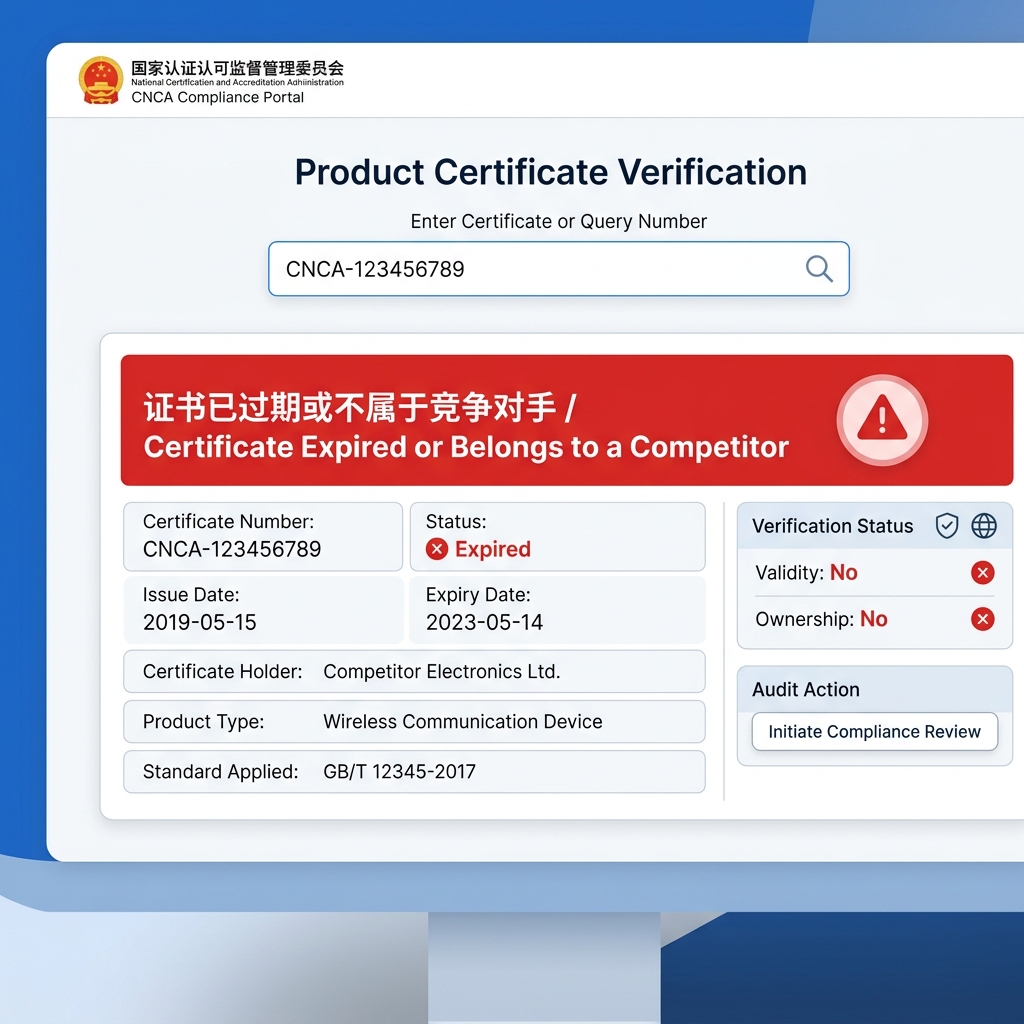
The CE certificate provided by the supplier lists their company as the legal manufacturer and owner (1). Therefore, the certificate number must be searchable and active in the official certification database (1).
The Inconsistency (1+1 ≠ 2): You copy the certificate registration number and query the issuing Notified Body's database (or China's CNCA system) and find that the number does not exist, or the certificate was issued to a completely different company, or it has expired.
5Digital Footprint vs. Claimed History
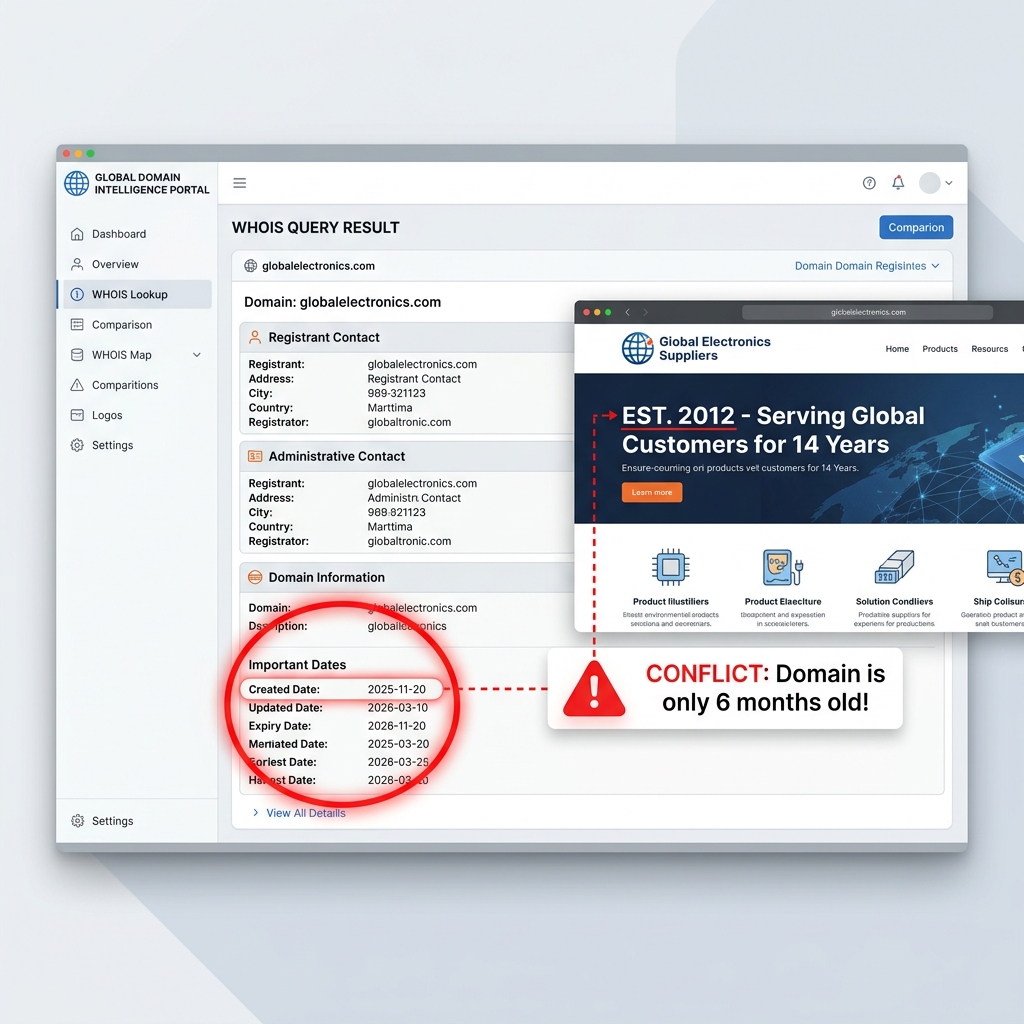
The website header boasts, "Established in 2012, serving global buyers for 14 years" (1). Therefore, their domain registration history and official ICP备案 must date back to that era (1).
The Inconsistency (1+1 ≠ 2): A WHOIS lookup reveals the website domain was registered only 6 months ago, or the website's ICP备案 is registered under an individual's personal name rather than the corporate entity.
The "1+1 ≠ 2" Logical Inconsistency Check Matrix
| Dimension | 1+1 = 2 (Logic) | 1+1 ≠ 2 (Mismatch) | Risk |
|---|---|---|---|
| Official Status | Active in state registry | Registered as 注销 (Deregistered) or 吊销 (Revoked) | 🚨 High |
| Payment Mismatch | Bank beneficiary matches invoice issuer name | Bank beneficiary is offshore shell or individual name | 🚨 High |
| Factory Claim | Manufacturing scope + industrial park address | Trading scope only OR registered to office/apartment address | ⚠️ Medium |
| Certificate Validity | Certificate number matches company on CNCA/issuer database | Not found, expired, or registered to a different competitor | 🚨 High |
| Domain age | Domain registered in accordance with company history | Domain registered recently OR ICP备案 matches an individual | ⚠️ Medium |
Chapter 5: Conclusion: Let Us Do the Heavy Sourcing Verification for You
Conducting a thorough 5-step audit is the only way to protect your capital and ensure business continuity when sourcing from China. By looking for the "1+1 ≠ 2" logical mismatches, you strip away the polished marketing claims of suppliers and examine the cold, official third-party facts.
But let's look at the reality of doing this yourself. To run a manual check on just one supplier, you must obtain a registered account on the Chinese government database (NECIPS) using a Chinese +86 phone number, bypass complex Chinese-character CAPTCHAs, translate pages of official Chinese legal text, use advanced OCR tools to extract the Chinese characters from red stamps on Proforma Invoices, and cross-reference certificate numbers.
Doing this takes 1 to 2 hours per supplier. If you are comparing 5 different suppliers, you are looking at nearly 10 hours of tedious labor. And if you make a single typo, your entire audit falls apart.
The Smart Alternative: VeriSupplier Risk Reports
We built VeriSupplier to solve this exact bottleneck. We have established local data infrastructure, direct corporate database API access, and a team of professional supply chain audit specialists in China. We do the heavy lifting so you don't have to.
When you submit a supplier to us, we run our proprietary 1+1 ≠ 2 Conflict Engine to check active corporate status, payment payee mismatch, business scope, physical address signals, and supporting website registry evidence.
Most paid reports are delivered within 1 business day. Every warning flag is tied to captured evidence, source context, and a practical next step before payment.
Don't Wire Your Deposit in the Dark
A focused pre-payment review can help you spot mismatched entities, unclear payees, and evidence gaps before committing funds.